

Benimaru’s Dad! Fire Force Season 3 Part 2 Episode 2 Review!
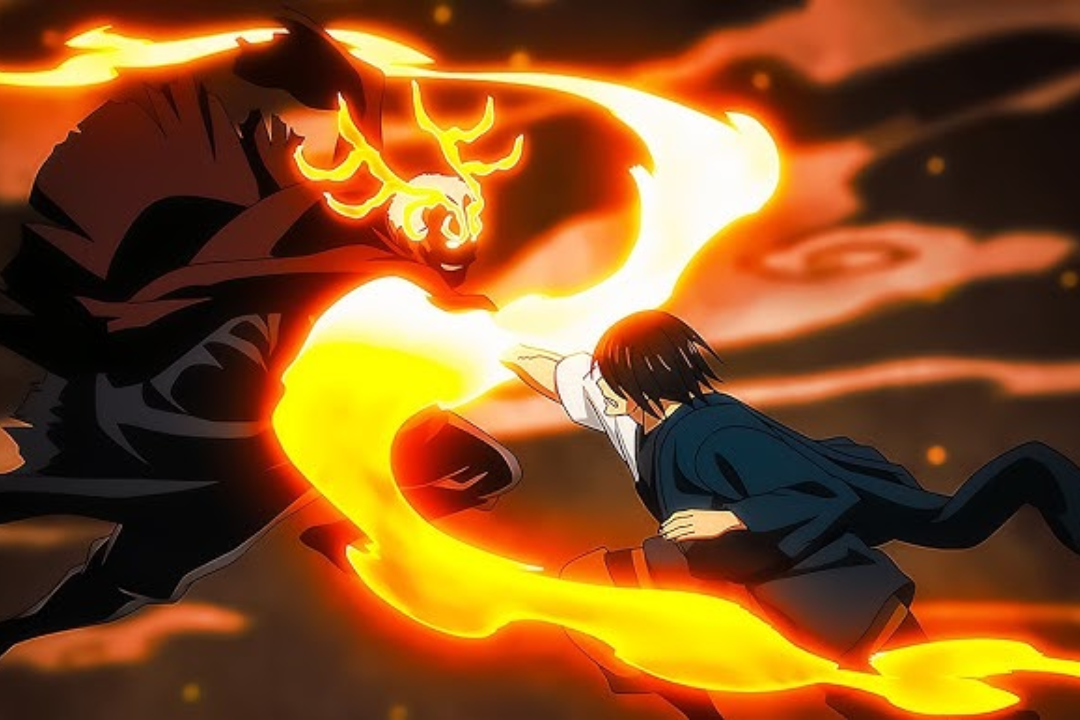
Fire Force Season 3 has finally made a fight that reaches the heights of previous seasons and it is of course a Benimaru highlight
Fire Force Season 3 Part 2 opens with the setup for the Great Cataclysm as Shinra learns about how his doppelganger took over for a few months and hints towards Iris being Amaterasu’s doppelganger.
Two episodes adapt full arcs in one go.
The Sun and Moon Together
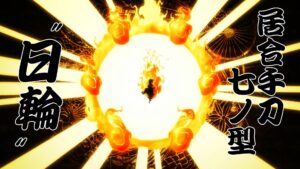
Fire Force Season 3 Part 2 Episode 2 and the 62nd overall episode is titled, “With the Sun at His Back”
This episode adapts Chapter 220: “Father of Proto-Nationalist” (pages 16-20), Chapter 221: “Asakusa Style” (pages 1-9), Chapter 222: “Company 1 Returns” (pages 6-8), Chapter 223: “The Rambunctious Brat Sets Out” (pages 6-14, 18-19), Chapter 224: “The Sun and the Moon”, Chapter 225: “Childish Moonlight” (pages 2-6, 10-11, 14-16, 18-19), Chapter 226: “The Burden Bearer’s Fate”, Chapter 227: “Unfinished Business” (pages 2-4, 9-20), Chapter 228: “A Souvenir for the Afterlife” and Chapter 229: “The Sun Wheel at his Back”, the last chapter being where the title is from.
Skipped Content
Only counting what is left of the chapters adapted from last episode, this comes at a whopping total of 10 chapters and 116 out of 171 pages adapted.
Essentially, this is a rare instance of an anime episode that is able to adapt a full volume’s worth of content, with the actual adapted material being about 68% of the overall manga content.
While taking on 10 chapters in one episode is impressive, it is how it managed to sacrifice certain sections without leaving potential contradictions down the line.
The episode removes the Company 1 content with Konyango, a reckless Company 1 member akin to Rekka whose existence seems to be skipped in the anime, and how Hibachi Shinmon finished off the female Infernal rather than Karim Flam “Thermoacoustic Refrigeration” (ice powers) and Huo Yan Li’s “Lantern Fist”.
This also skips Hibachi heading off to Asakusa but instead be already positioned there, as if he was spawned from the seventh pillar, skipping a chapter’s worth of content to secure the episode’s pacing.
Skipping the part of Konro telling Benimaru, Benimaru sees Hibachi on the television and needed no words, except to immediately eat his “this is the Empire’s fight” stance by saying it was his, which ties into the first lesson we saw the old man teach a young Benimaru in the flashback, to not get into fights that are not his.
However, this does have some downsides.
The anime also skips Benimaru’s talk with Shinpeita, which revealed a lot more about Benimaru’s position in Hibachi’s life than the anime did.
Rather than be a simple adopted son or orphan taken in by the Asakusa boss, Benimaru was an adopted son who did not want the burden or feeling of being someone’s substitute son and that Hibachi never had the time to have a family of his own.
The fight with Kantaro is only skipped and is simply mentioned in passing during the flashback, which is fine.
What is removed, however, is the scene after Hibachi’s death, of Benimaru changing the old boss’ way, from simple murder to making a celebration out of every death as a way to counteract the despair and reduce the value of life itself, which could be part of how Shinrabanshoman crafted his solution to the Great Catalysm by the end of the series.
A good reason for this has to do with how we were introduced to Benimaru with the same scene, just without Konro clarifying the Beni Style Send-Off to those surprised by the changes to Asakusa’s Infernal exorcisms.
Peak Art and Action
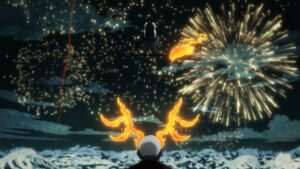
The entire fight drips with pure visual flair and maximizes the beauty of Fire Force’s anime fire effects.
Although mechanically the fight is not special, what matters is that it is able to convey the beauty of Asakura’s imagination by converting the ocean water into traditional Japanese painting style and Benimaru’s attacks as more akin to fireworks than destructive flames.
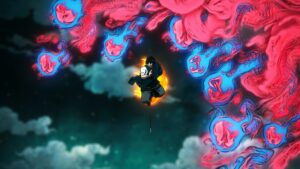
Every move turns the landscape into classic Japanese art, the world changes because the imaginations of Asakura are restoring old Japan from the post-Cataclysm Tokyo Empire.
It also helps that Benimaru’s final move uses the literal power of the other members of Company 7, their matoi flag poles.
This is what makes Benimaru “the Strongest” of Fire Force.
While a unique existence born as the sole dual-type, a Second and Third Generation, Benimaru’s raw power does not come from explosive force or a desire to destroy everything, including himself, but rather a free form that exists for the sake of itself.
He knows his existence is fleeting, so he treats the Infernals as people in their last moments.
Rather than live with guilt like Hibachi (who died at the hands of a grief-stricken boy whose mother turned Infernal), Benimaru chooses to live as ephermal as the fireworks, knowing his mortality but also being responsible as one with the strongest fire.
So this clash against a perception of his father figure is more than a son surpassing and erasing his father.
This is an honorable fight to restore Benimaru’s personal prestige, to settle an old man’s regrets upon death, and most importantly, send him off with fireworks not as a soldier but as a beloved guardian of Asakura, the father of proto-nationalism.
CLICK HERE TO JOIN THE ANIME EXPLAINED WHATSAPP GROUP CHAT NOW!