




THE FOUR APOSTLES EXPLAIN EVERYTHING! Gachiakuta Chapter 172 Spoilers!
Gachiakuta’s greatest mystery has been solved: God is dead and we have killed him
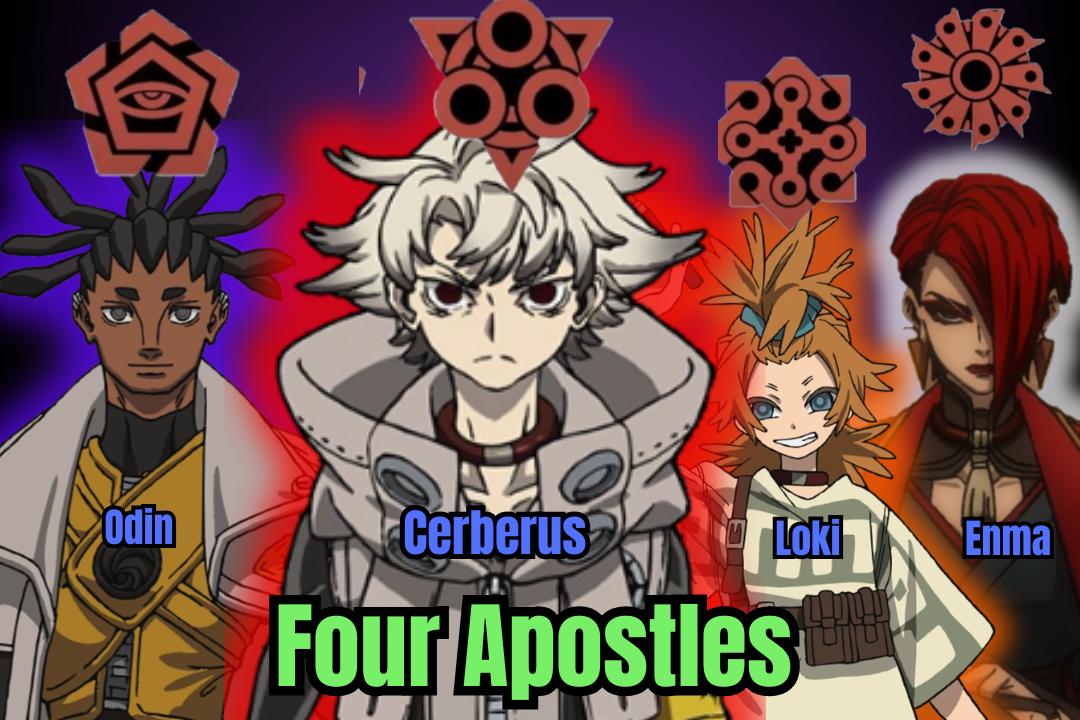
In the previous Gachiakuta chapter, Kyouka reveals to Rudo the existence of the Four Apostles, the four closest to the God race
Gachiakuta Chapter 172 is still titled, “United by Fate”
Released on July 29, 2026, Part 2 has 17 pages.
The whole chapter is surprising long with a total of 26 pages, although this part is a whole chapter in of itself but this could also be due to the significance of its contents.
Apostles and Gods
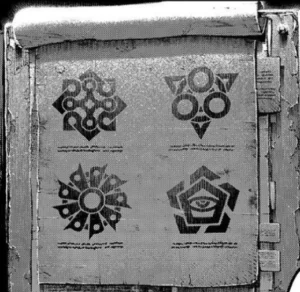
The chapter begins where we left off with Kyouka noticing the holes in the records and so she reveals four symbols Rudo has seen before.
The symbols first appeared in Chapter 87: “Ancestry” in Canvas Town, painted by fellow Apostle, the Spellcaster Macaca Icol.
We know the downward triangle with three circles as the Surebrec Logo, the logo of the Watchman series.
The eight-pointed star is the Spellcaster, Macaca Icol.
The flower is Ophelia Amne, the first Hell Guard whose records the Kyouka Family have kept safe for generations.
Finally, the eye symbol, which resembles the one on Arkha Corvus’ nape, is the Nameless Recorder.
If you notice, three of the Four Apostles have been named and they have themes.
Canis Surebrec is dog-themed because Canis the genus for wolves and other canines, while Surebrec is an anagram for Cerberus, the three-headed dog guardian of the Greek Underworld, which also explains Rudo’s wolf transformation when fighting against Mymo’s God form.
Macaca Icol has multiple meanings too.
“Macaca” is the scientific term for macaques, a type of monkey.
The surname “Icol” is the word “Loci” spelled backward and is the plural form of the Latin word locus, meaning places or locations or the protective spirit of the place, since Anima is involved.
It could also be Loki, the trickster god of Norse myth.
Ophelia Amne, the First Hell Guard, has a flower theme, with Ophelia from Hamlet wearing a flower garland before drowning to death.
Ophelia also means “help” in Greek, signifying her role and that of the Hell Guard as Apostles.
If we follow the anagram theme, then Amne is Enma, the god of the underworld and judge of the dead in Japanese Buddhist mythology.
Cerberus, Loki, Enma, and possibly Odin.
Greek, Norse and Japanese
Since there have been six generations of Spellcasters, the Four Apostles existed at least 150 to 200 years ago.
Crows Everywhere:
At the end of the chapter, we see a familiar crow watching over Rudo and Kyouka.
This is clearly Kuro.
This is due to his Vital Instrument or his unique ability to shapeshift into a crow.
Chapter 113: “A Vague Identity” gives us a thorough read on Kuro the Information Broker, as someone with an attachment towards
What if Kuro is a living Vital Instrument or a bird given that power through the anima?
Given he existed for over a hundred years, far beyond a normal human or bird lifespan,
Corvus and the Nameless Recorder
The Nameless Recorder could be two people rather than just one of them.
The strongest evidence for this is that Kuro who is the most likely and obvious candidate to be the Nameless Recorder is based on Muninn from Norse mythology, one of Odin’s two crows, which represents memory, which Kuro lacks.
And another candidate with ties to crows would be Arkha Corvus, the leader of the Cleaners.
The word “Arkha” has a few possible origins:
The name “Arkha” may come from the Sanskrit word arka (अर्क), which means the Sun.
“Arkaa” primarily refers to a vessel used in Hindu rituals for keeping flowers offered to gods.
This fits Corvus’ darker skin tone and his role, which is likely the Vessel of the Nameless Recorder.
He has a white eye tattoo that resembles the Nameless Recorder’s logo and it magically moves on his own, hinting that it has a life of its own.
In Chapter 116, titled “Rudo Surebrec the Cleaner”, when Rudo declares his intent to be used by Corvus and the Cleaners to figure out the truth of the world, Corvus is emotionally moved, as well as his eye.
Corvus might be a fitting candidate for the Nameless Recorder or even the entity behind the living eye tattoo.
It is easy to see how Corvus and Kuro could represent both of Odin’s crows, Muninn and Huginn and Huginn’s name means Thought, as in Anima, the energy of the dead gods.
Put together, we have a memory-keeper who was given an original Vital Instrument like the other Four Apostles.
When the Nameless Recorder’s lineage is revealed, the whole mystery will be put to rest.
The Confession of the Four Apostles
Kyouka confirms that the Four Apostles are humans that serve as a bridge between humans and gods as their mission is to watch over humans and have an audience with superior beings.
However, Kyouka notes that they have failed in that role because each account from the Four Apostles is filled with regrets, just like Canis Surebrec’s letter from Chapter 105: “Behold what it holds” from Volume 13.
We do not have enough details on what exactly is written but a French translation of Gachiakuta Volume 13 apparently revealed more text from the scratched portion.
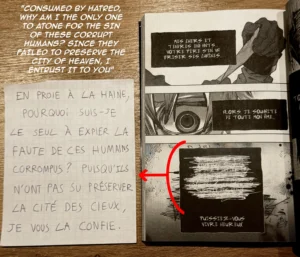
“Consumed by hatred, why am I the only one to atone for the sin of these corrupt humans? Since they failed to preserve the city of Heaven I entrust you.”
And of course, the last part we have all seen:
“Live long lives”.
DEAD GODS
From here, Rudo concludes that the humans and the gods went to war since the Four Apostles failed as intermediaries, a conclusion that shocked Kyouka since they had the same conclusion.
There is a possibility that the humans must have killed the gods.
If the gods were powerful enough to empower humans with Vital Instruments, especially the likes of the Watchman Series, it would be hard to believe they would have fallen to human hands.
Then Kyouka looks at both Rudo’s 3R Glove and the handcuff she put on him.
She realizes how the first generation of Givers might have defeated the gods.
This compels Kyouka to tell the recorder to delete everything discussed and to tell no one of what they heard.
Kyouka concludes the investigation.
Then Rudo brings up how the price for 3R’s power is too good, which leads him to conclude that it might have something to do with the gods.
Rudo is also a descendant of someone close to the gods, one of the Four Apostles, Canis Surebrec.
Since the Four Apostles met the gods, the gods would affect their bodies in some way.
Kyouka points out that Vital Instruments lose their power when their user dies because the Anima comes from them directly yet relics like the (1) Watchman Series, (2) Macaca’s Pen Vital Instrument and (3) the Hell Guard equipment retain their power even after their original user’s death, allowing them to be passed on.
A crow overhears all of this and as we established, this is very likely Kuro.
Notice that when Kyouka talks about the Four Apostles receiving power from the gods, the textbox forms an hourglass shape over a sheet of paper or sand or possibly even skin and since this page shows the four object types touched by the living gods, then it is possible that this substance is related to the Nameless Recorder, like the skin or tattoo of the Nameless Recorder that is passed on as a means for that being to live on forever.
Kyouka concludes the Vital Instruments also share that trait.
A New Alliance
Kyouka escorts Rudo out, telling him that she will have someone escort Rudo to the hospital where Enjin was kept.
Rudo is impressed by Kyouka knowing a lot, with her saying research is her hobby.
Kyouka finds Rudo unusual as most Givers refuse to disclose any information about their Vital Instruments to the Hell Guard.
Rudo sees the Hell Guard as like the Apostles, a police force and seekers of divine justice but unlike the Spherite Apostles, they allow Rudo to have his side of the story heard rather than insist on a narrative.
Furthermore, when Kyouka was thinking about Rudo’s power, she looked like her youngest brother Zanka so he let his guard down.
Kyouka warns him not to let his guard down next time.
The Hell Guard Mantra Was Right!
“The greatest threat of all is human beings!!”
This mantra has appeared ever since Chapter 57: “Memories of an Average Joe” in Zanka’s flashback.
God is Dead
We have killed him.
But this time, it is a tangible mistake.
Even if the gods were invaders, by not destroying their remains or rather because we are unable to, the gods’ Anima permeates through the Earth.
This explains why the Spherites abandoned the lower class of the Ground to fend for themselves: to prevent the gods’ wrath from rising.
This wrath might be related to Rudo’s inner curse or the object within him that Tamsy Caines wants to bring out.
Tamsy might be a Canis Surebrec descendant from a different line, one who opposes Canis’ legacy and wants to see everything be destroyed: both the Sphere and the Ground, which would fit the nihilistic design of Tamsy since he feels more like the Joker than some advocate for the alien gods.
Yet this zone of dead gods is precisely what creates Givers in the first place.
Kyouka says that the real enemy are humans, as they are the most terrifying creature out there.
They are capable of killing beings of superior or impossible strength.
Most of all, humans are the ones with actual desire to pollute and destroy the world.
Hence why the world is filled with so much anger
That anger takes the form of Trash Beasts, wild Anima out of anger at any living thing.
And this revelation is merely the beginning of Gachiakuta’s endgame unfolding.
Each holder of the Watchman Series, the Pen, the Hell Guard institution and associates of the Nameless Recorder have pieces of the truth through their experiences, Vital Instruments and character writing.
It is up to Kei Urana to stitch everything together in the near future.
CLICK HERE TO JOIN THE ANIME EXPLAINED WHATSAPP GROUP CHAT NOW!