



The Holy Trinity of Anime. Fire Force Season 3 Part 2 Episode 3 and 4 Review
Before the Great Cataclysm truly begins, we get to know why Shinra’s role as the Hero is a threat to the story of the Evangelist.
In the previous Fire Force episode, Benimaru confronts his adopted father’s doppelganger.
Fire Force Season 3 Part 2 Episode 3 and the overall 63rd episode is titled, “Birth”
This episode adapts the entire 21st arc of the manga, the Kusakabe History Arc, covering Chapter 230: “The Cataclysm Marches On” to Chapter 233: “Guardian Angel ”
The Holy Trinity of Fire Force Explained
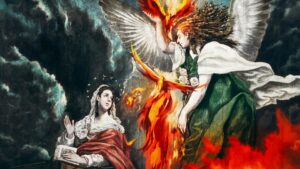
We need to understand how Shinra is essentially modern Jesus.
First, we begin with the Evangelist, the source of Adolla.
As stated at the start of the episode, Adolla is the world of human imagination, what people think of things and other people.
That is why the water and moon look so cartoonish.
However, at the end of every imagination is death, so humans imagine death itself and that is the conclusion of the Great Cataclysm.
The Evangelist is both the source and final product of Adolla, where death is the origin and final point of imagination.
Humans are the only beings with imagination, which is why animals in the Chinese Peninsula are able to speak, due to the Tear in Space and thus contact with Adolla via the original Great Cataclysm.
In other words, since the Fall of Adam and Eve, their banishment from Paradise into the Earth, the concept of death was imagined as despair in itself via the Evangelist and therefore death-desire is the Collective Unconscious.
When the original Cataclysm failed, remnants of the “images” people had from the real world leaked out into Earth, which resulted in the Fire Force world looking like an anime.
This also led to the existence of certain individuals who were based on the strongest, most important legends.
How Fire Force Explains the Real-Life Virgin Mary
Let’s begin with Mari.
Her original name is Mari Abe and that is obviously a reference to the prayer Ave Maria (Hail Mary), meaning she is a human based on people’s perception of the Blessed Virgin Mary.
However, we see that through a fictional version of the Mother of Jesus, we can come to understand why the choice to even have a virgin birth
To begin with, Mari was completely unaware of how she was able to have a virgin birth.
This shows that she is the only being in all of Creation capable of the miraculous, not needing a father to bear a child.
But it is the struggle of choosing to have such children regardless that this random Japanese anime has been able to be more upfront about than the Biblical narrative.
Mari was seen unfavorably by ordinary people, including her own parents.
She is an anathema, an unwanted existence, because she not only defies biological laws, which the Temple or status quo uses to maintain normalcy, but that her existence is itself a discomfort.
When religion marries power, doubt and inquiry are unwanted.
Yet the true practice of religion is in the rejection of the desirable world and the service of the unwanted (James 1:27).
By rejecting an abnormality, a new phenomenon like the Virgin Mary, the world is rejecting a cure to its dulled senses and weakened body.
In Scripture, we do not really see Mary’s struggles but the story clearly outlines it via the Gospel of Matthew, a Gospel that is framed within the context of Jewish tradition and prophecy.
While Mary is more of a side character in the first segment, we do see her struggle via Joseph, her husband, who wanted to silently cancel the bethrotal to her to ensure she is not humiliated.
This is a struggle for Joseph.
If they stay married, Mary will be called an adulteress for having a child that is not Joseph’s before marriage, especially if Joseph chooses not to lie and instead say who the father is.
But at the same time if Joseph leaves Mary to the wilderness of society, she is even more unprotected and will be open to exploitation.
In spite of her purity, Mary would have ultimately been another victim of the sad history of women and another rejected prophet whose message does not reach the ears of a patriarchy.
And yet he made the brave choice to accept her.
Notably, this motif of adoption and willingness to stand strong amidst social discrimination is found in the character of Vulcan Joseph, the family of CARPENTERS and Engineers responsible for Amaterasu.
250 years ago, the Joseph Family helped build the Tabernacle, the receptible of the divine Amaterasu.
In Judaism, the Tabernacle was the tent that housed the Ark of the Covenant.
In Christianity, that would be where the Body and Blood of Christ are kept.
It is also another title for the Virgin Mary.
It is also a reference to the home built by Joseph for Mary and Jesus.
Sho the Angel
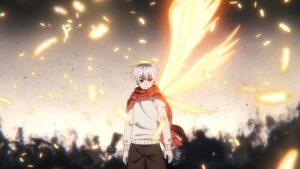
The Trinity is a hard concept for grasp even among mainstream Christians that believe in it.
While it is a subtle but also common motif, on top of the sacredness of the Number Three, actually depicting a “Trinity” of the Father, Son and Holy Spirit is not commonly treated as a main storytelling device.
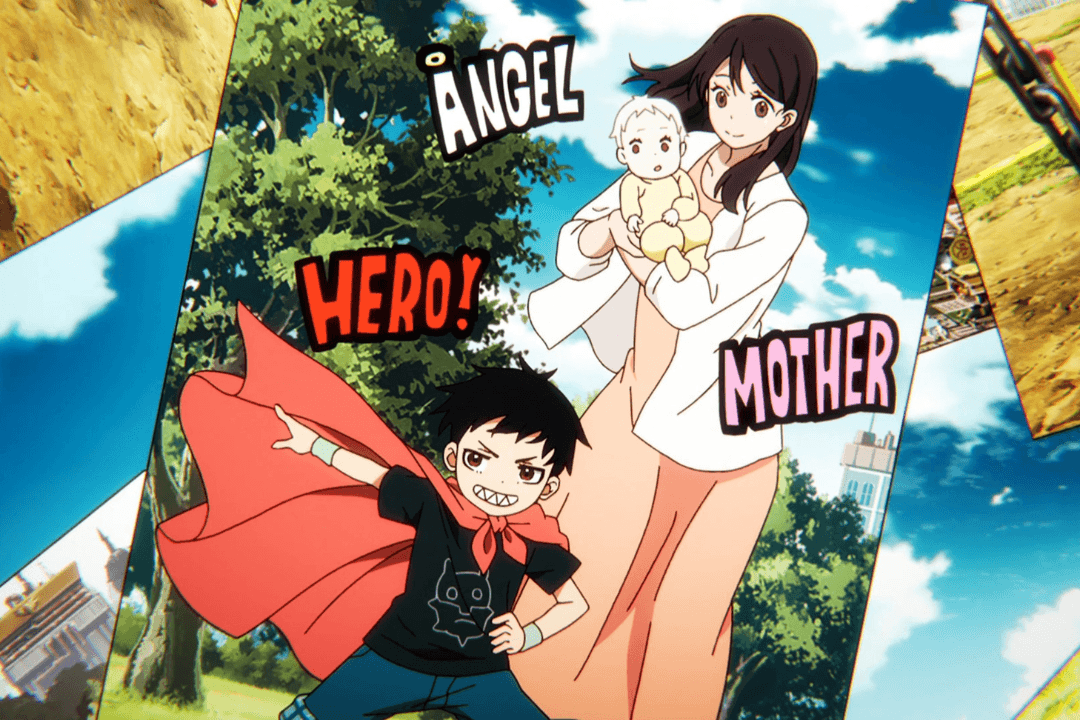
In Fire Force, this is the Mother (Mari), the Son (Shinra) and the Angel (Sho).
This makes Sho more like the Holy Spirit, the Giver of the Breath of Life and the Helper or Paraclete, which fits his role and his title as Angel, one who gives aid.
In a way, his Severed Universe, the ability to “freeze” time by stealing the universe’s heat for a while, is correlated to the Holy Spirit, as heat is life itself.
The Duality of Salvation
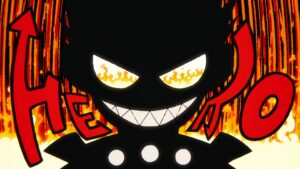
Fire Force Season 3 Part 2 Episode 4 and the overall 64th episode is titled “Savior”
Released on January 30, 2026, this episode adapts Chapter 234 to Chapter 238
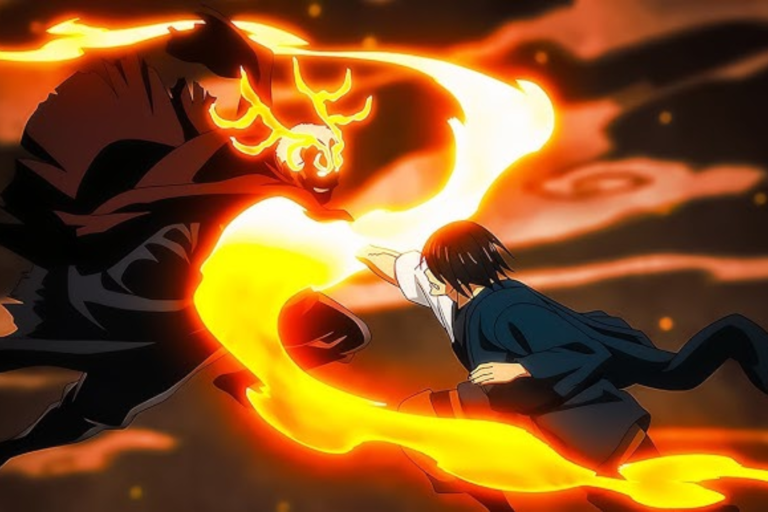
The final Infernal Titan takes the form of a black sun in control of the Infernal version of Raffles I, the founder of the Tokyo Empire and Holy Sol Temple
But when Shinra takes out the Black Sun, we see a paradox at play.
Humanity has always desired a Savior in the form of Jesus Christ from ancient times.
That desire is retained by the Collective Unconscious, which is the Evangelist in the current form.
Along the way, religion was organized by humans to give meaning to suffering and an institution to explain the Savior.
Religion, however, also requires physical representations to maintain its social influence in the form of hierarchies.
The founder, Raffles I, is essentially the First Pope, upon which the Holy Sol Temple was built.
However, like during ancient times, no one knew what the Savior looked like, only his promise.
The people do know what their High Priest or First Pope looked like.
With Shinra, the Second Coming of Jesus, slaying the Second Coming of the First Pope, the most familiar image of Salvation (Raffles I) was the one being mourned.
And the False Messiah functioned exactly like the real one, a Sacrifice for the salvation of souls.
All Raffles spouted was the need for humanity to return to the flames of destruction, a teaching the people did not understand.
Just as the real Jesus provided teachings that ordinary folk in his day did not understand.
Yet at the same time, no one knows the real Messiah or the value of life that Shinra wants to protect.
So in the end, like the real Jesus, Shinra is perceived as the Devil.
Especially because like the real Jesus, Shinra has directly opposed the religious authority of his day, the Holy Sol Temple, that is trying to silence the truth of the Messiah’s existence.
Because Shinra the True Savior threatens the status quo’s whole point.
Yet he also subverts and fulfills the spirit of their Laws, a spirit that is missed because what matters to the Holy Sol Temple is the visible sign, not the inherent spirit behind it across space and time, a spirit that last episode we establish comes from more organic religious movements and mythos that coalesce into Jesus (Shinra), Mary (Mari) and the Angel (Sho).
In Adolla, perception is truth.
The “devil”, the despair of humanity amidst the countdown to destruction, is strengthened.
Because in spite of the literal Devil in this episode being their physical savior, the False Messiah Raffles I, an Infernal copy of his no less, the people have spent 250 years of religious indoctrination and familiarization perceiving Salvation as Raffles himself.
This pair of episode builds upon the surprisingly solid religious themes, from capturing Mary’s struggles as the mother of a forgotten promise, treated as an anathema in a religious status quo that normalized struggle to Shinra being the rejected Cornerstone because he murdered the physical representation of the status quo’s Institution
CLICK HERE TO JOIN THE ANIME EXPLAINED WHATSAPP GROUP CHAT NOW!