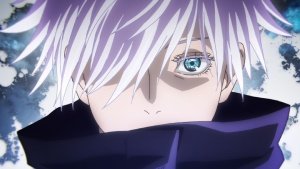
Yuji vs Yuta Executed FLAWLESSLY! Naoya CINEMA! Jujutsu Kaisen Season 3 Episodes 1 and 2 Review!
The premiere of Jujutsu Kaisen Season 3 spawned an iconic meme and some of the best anime cinematography of the decade that deepens the lore of the Zenin Clan and Yuji’s internal struggles.
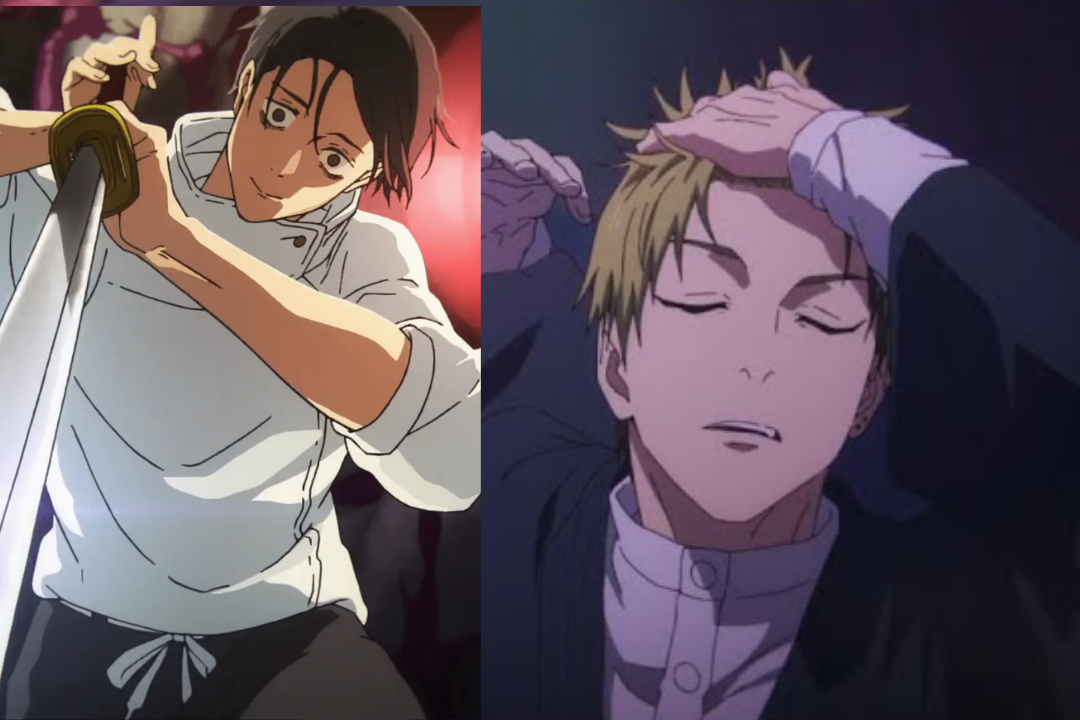
In the Shibuya Incident Arc of Season 2, we ended with Pseudo-Geto revealing his plans and Yuji clapping in the ruined streets of Shibuya while Yuta returns from Kenya.
The premiere completes the Itadori Extermination Arc (Chapter 137: “Hard and White” to Chapter 143: “One More Time”)
Episode 1: Execution
Episode 1 of Season 3 and Episode 50 of the series overall is titled, “Execution”
This episode adapts
The episode starts off with the Inhuman Makyo formerly known as Tokyo.
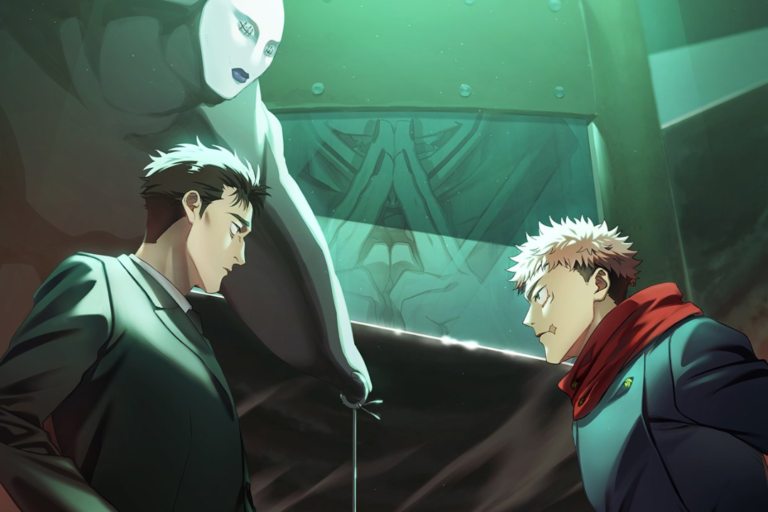
Rather than see Yuji clap and trigger the Cursed Spirits, we focus first on Yuji dealing with his guilt.
Anime Expansion: Yuji’s Guilt
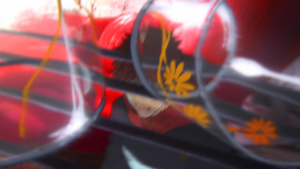
The anime executes Yuji’s guilt with such deliberation, such strong feeling.
So many shots and closeups of Yuji’s red hands follow this whole sequence as Yuji is not looking at the Shibuya Incident but at his own hands still being red.
We see even a shot of him from the dish rack still washing his hands while behind him is a giant open red hand.
And he washes them in an abandoned building, as he is now exiled from Jujutsu Society and a self-imposed exile for his perceived sins.
In a building abandoned due to Sukuna’s massacre and Kenjaku’s release of 10 million Cursed Spirits all over Tokyo.
Sukuna’s presence being minimized throughout the Culling Game is important yet this is a reminder of how he will inevitably ruin the story once again as he smiles, eager for the day his plans come to fruition
We only see him when Yuta seemingly ends Yuji’s life in the next episode.
We see a different opening act as Yuji jumps out of the building as soon as he sees a giant Cursed Spirit try to reach for him.
However, this is actually the opening to his fight against Yuta in the theater, which we return to.
The episode starts in medias res, as we end the cold open on Yuji being trapped by Yuta’s hold.
When we return to Yuji’s POV after the Zenin Clan scene, Yuji thinks of his trauma and sits on a staircase with a large window, which resembles the first key visual of Season 3, a favorite bit of imagery from Gosso’s own storyboards since this is also featured in the cour’s ending theme, Yoake no Uta (Song of Dawn).

Much of the scenery is draped in red, reflecting the mindset Yuji is in, filled with guilt and drowning in the blood of the people his body has killed.
A Tighter Family Than Ever

The Zenin Clan section begins with the talkative Naoya hurriedly entering the room, with Maki and Mai’s mother in tow, acting as a maid for the spoiled brat.
The set design is not only more realistic via the anime medium but reflective of how empty the place feels.
There is barely anyone around, except for two other men.
Jinichi Zenin, the brother of Toji and thus a nephew of the late clan leader.
And Ogi Zenin, the brother of Naobito and father of Maki and Mai.
Besides how Naobito died from his wounds and the household is in a state of mourning, the Zenin Clan has clearly been experiencing a great decline.
Once again, Shota Goshozono applies his directoral brilliance by making one simple decision that diverges from the manga.
Rather than follow a traditional normal room, he emphasizes the claustrophobic lack of space in the room of so many men craving power with the use of closeups, tight space, 3D shadows stuck to the wall and a swinging light.
The men, who seek power and ownership over the Zenin legacy, are trapped inside the confines of their conservative worldview that is becoming unstable.
That light source is their last source of strength and it is beginning to fade, swinging as if it is ready to fall and break.
First, we see this effect when Ogi corners him with his blade while Jinichi was about to pounce on him due to his insults to both older men (his uncle and cousin respectively).
The world is becoming smaller thanks to Kenjaku’s Culling Game and the removal of Satoru Gojo as the world’s balancer.
The politics of Jujutsu Kaisen have never been better depicted than here, an average land-owning family receiving the last will and testament of their clan leader and the struggle for inheritance due to an emerging uninvited party (Megumi).
You instantly feel like these three dudes should NOT be this close together in one room.
When the lawyer (played by the late Tomomichi Nishimura, who is famous for his role as Onoki from Naruto and Coach Anzai from Slam Dunk) reads the names of the three men, we see their faces behind the doors, furthering that sense of isolation and the feeling of the world slowly encasing them in their conservative prisons.
On top of the many artistic and film references of the opening “Aizo”, we also have some in this episode, such as the image of the Hei and Zenin Clan being a likely reference to the Overlook Hotel guest photo from Stanley Kubrick’s adaptation of “The Shining” (1980).

Aside from how everyone in both photos is dead, in the context of the Zenin Clan photo, we see one predominant thing: the lack of women.
Women are not treated as clan members but servants, slaves, objects and that includes the wives of the men present.
This is exemplified in Naoya’s treatment of Maki and Mai’s mother, who acts as a glorified nanny in spite being the wife of the clan leader’s brother, his uncle Ogi, who does not even comment on Naoya’s treatment of his wife, his property.
This tells us that because of Maki and Mai’s perceived weakness, the woman is ostracized from the clan she married into and thus the curse of Ogi’s line is pinned on her weakness as much as it is Ogi’s.
This could also explain why she is nameless.
Anime Addition: Naoya’s Codepedence Revealed
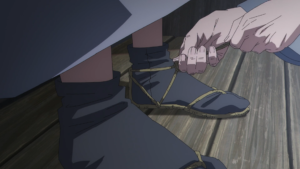
The anime adds one more scene.
Naoya prepares his waraji sandals, which are just a flat woven rice straw with straps that need to be trimmed to fit tightly.
Maki and Mai’s mother cuts the straps each time he has to prepare to leave the house.
This may seem like efficient footwear but in reality, this reveals a lot about Naoya, mainly that he is ultimately a codependent manchild.
While Naoya prides in his skills as a Special First Grade Sorcerer like his father Naobito, he lets women do menial tasks that he sees are beneath his status but that also reveals an underlying weakness to the man: he does not bother to try anything.
His misogyny is deeply rooted in cultural tradition but it could also be that he enjoys humiliating and making any woman serve him to fill the gap of an absent mother or to sate a dissatisfied, bored ego.
Naoya is Absolute Cinema
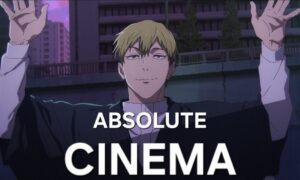
Naoya appears, preparing his plan to use the Inhuman Makyo of Tokyo as an excuse to kill Yuji and find Megumi before he can claim the Zenin inheritance.
Naoya eats up the entire scene with his screen presence, accompanied by Koji Yusa’s unique alluring voice, a Kansai dialect most recognized due to his role in Bleach as another snake, Gin Ichimaru.
Both characters share a similar history of being unexpected beloved, especially by the female audience.
This is doubled down by how he also voices Jikka from Hell’s Paradise in this Winter Season.
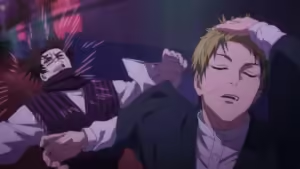
At the start of the confrontation with Choso, Naoya does a hair flip, expressing his dominance in this battle, all to show his comfort.
Credit to Teppei Okuda for this glorious meme
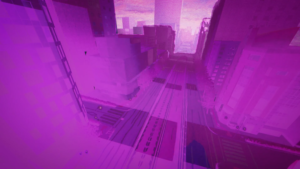
Suddenly, the entire city in draped in purple, a representation of Yuta Okkotsu’s immense Cursed Energy volume, the confirmed second largest in the series next to Ryomen Sukuna.
The purple is a fitting color, perhaps to represent Yuta’s Gojo lineage and it helps that Yuji mistakes him for Gojo because they are distant relatives.
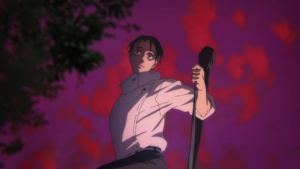
Eventually, Yuta joins the party, asserting his position as Yuji’s executioner while striking a Jojo pose.
By wrecking some concrete, Yuta asserts his power right away.
Naoya tries to “deescalate” by pointing out they are on the same side and yes, that is where we get the “Absolute Cinema” pose.
The pair of pursuers split up and we can now talk about each fight individually.
Anime Removal: Goodbye Yuji Car Punch
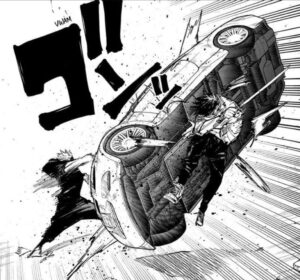
Some fans have complained that this feat of Yuji’s ridiculous strength being removed makes the anime fight less engaging and there are a few points in favor of that criticism.
Yuji’s strength is often highlighted in the series but this one has extra presentation points for being unexpected.
Some treat the replacement in the form of a theater fight to be an inferior version yet as we will see, Gosso made that scene for a reason.
Execution is Just Cinema

The choice of a traditional Japanese theater being the last battleground is perfect because this is subtle cinematography at play, where Yuta “plays” the role of an executioner.
The point of this scene is to establish that everything Yuta is doing is just pretend.
He is an actor assigned by Jujutsu Headquarters to carry out a role but this is just a role and an act.
Nothing here is real but since he is under a Binding Vow and that he needs to secure Yuji’s escape, he does take this seriously.

As shown when he bathes the entire theater in the blood of a Cursed Spirit that he had slain before coming to pin Yuji.
Again, the color script is part of the story here as purple is Yuta and Gojo’s color, the combination of Positive and Negative but also of Cursed Spirit blood.
By bathing the theater in the blood of a Cursed Spirit, Yuta consecrates the location, a place of make-believe, into a sacred space for sacrifice, a space for execution.
Executions in history are all about presentation, to strike terror to enemies and awe over the state’s power before the citizens.
But the two men here are alone and sending Yuji to a theater is a subtle, easily missed message that they are both on the same side but they have to play their respective roles while a “contract” (as an actor) is at play.
Episode 2: Once More/Again

Episode 2 of Season 3 and Episode 51 overall is titled “Once More/Again”
This episode adapts Chapter 141: “The Front of the Back” (pages 15-19), Chapter 142: “A Big Brother’s Back”, Chapter 143: “One More Time”, where the episode gets its title, and Chapter 144: “That Place”.
Surprisingly, this episode does not contain too many deviations from the main material, unlike the first episode, which makes radical changes for solid cinematography.
Naoya and Naobito’s Projection Sorcery Has a DIFFERENT Format
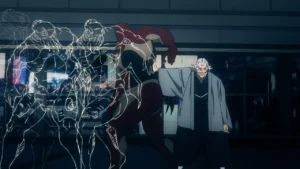

Once again, we are seeing the subtle brilliance of Shota Goshozono’s directoral vision at work here.
In Season 2, Naobito’s Projection Sorcery takes the form of “hand-drawn” frames, meaning that Naobito maps out every single frame of his movements within that 24 fps limitation.
However, with Season 3, Naoya’s Projection Sorcery is radically different as we do not see every single step or frame being drawn but rather, multiple bluish “projections” of Naoya coming out at once.
This shows a technique of digital animation called “onion skinning, which creates faint, semi-transparent “ghost” images of previous and/or next frames while drawing the current one, which saves time in the animation process while making the whole scene or cut easier to process and view.
Why such a change?
This is because Naobito is an animation traditionalist, as much as he is a social one.
Naobito created Projection Sorcery based on his hobby of watching anime and given he is 71 years old, he must have preferred older anime, especially those that are predominantly hand-drawn.
His technique’s format did change over the years as according to the Jujutsu Kaisen fanbook, Naobito was an otaku but more on the traditional side and therefore followed hand-drawn storyboards as the basis for his technique, which he invented.
When Naoya inherited the technique, it is likely he was less of an enthusiast and more of a casual enjoyer who was excited over the fast motion.
The ease of computer animation may not replace the quality of the art but it still matters in driving the engine of progress, as we see that even neophytes and arrogant schmucks like Naoya can pilot their bodies through the mechanisms of Projection Sorcery.
The anime is doing another important thing, which is foreshadowing how Cursed Techniques can change in a generation as shown in the battle between Sukuna and Yuji, comparing their Shrines.
More Details: Yuji’s Infancy

One nice detail added is that baby Yuji is covered in red petals, which also coincidentally look like blood.
This ties into his heritage and the method in which he was born, along with the bloodstained life he will have.
Another one is the way Kaori Itadori’s body looks.
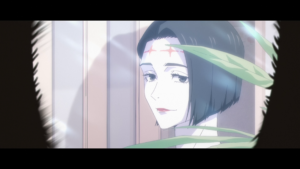
Besides the bright lighting due to Yuji’s premature eyesight as an infant, we see that in contrast to Wasuke and Jin, Kaori’s skin color is freakishly pale.
Some fans also notice the slight difference in pigmentation between Geto and Kenjaku but it is made more clear with the scene where Geto momentarily chokes Kenjaku by the neck when Gojo calls out to him before being sealed.
Staff for Both Episodes:
Storyboard: Shouta Goshozono (series director)
Episode Directors: Shouta Goshozono, Yousuke Takada
Assistant Episode Director: Nana Ueda
Chief Animation Director: Yousuke Yajima, Hiromi Niwa, Souta Yamazaki, Mitsue Mori
Animation Director: Takafumi Mitani, Teppei Okuda, Nozomi Nagatomo, Yuuko Ebara, Yumi Horie, Tomomi Noda, Yousuke Takada
Assistant Animation Director:Chihiro Shimada
Key Animation: Takafumi Mitani, Teppei Okuda, Masahiro Tokumaru, Mitsuko Baba, Shinsaku Kouzuma, Sangeun Song, Keiichirou Watanabe, Yakumo Crack, Xuanjing Wang, Mari Oda, Nobuyuki Itou, Adam Zheng, Weifeng Ji, Reimi Eda, Yazhi Lu, Yurie Muta, Su-Min Oh, Yousuke Takada
CLICK HERE TO JOIN THE ANIME EXPLAINED WHATSAPP GROUP CHAT NOW!